

In a competitive property market, decisions are often driven by urgency—limited inventory, rising prices, and pressure from intermediaries. However, experienced buyers know that the real risk is not missing a deal, but entering one without proper legal clarity.
Within the urbanized environment of Delhi NCR, Real Estate Fraud has come a long way since those times when fraudulent activity was easily discernible. Nowadays, fraud involves legally complex procedures where all documentation may seem correct but proves otherwise.
For investors, small entrepreneurs, and even ordinary buyers, the difference between a wise investment and a serious liability lies in the depth of verification. This manual offers a realistic verification protocol aimed at minimizing the risks associated with such situations.
Why Legal Verification Makes for a Safe Property Investment
A property’s value is not determined only by its location or price—it is defined by its legal strength. An expensive property with poor documentation can quickly turn into a financial burden.
In many disputed cases, the reason for this problem was that buyers had documents in their possession, yet failed to verify those documents.
Legal verification is all about validating the authenticity, integrity, and legality of your property and its documentation. Without following this procedure, you make yourself vulnerable to Real Estate Fraud.
The Changing Nature of Real Estate Fraud in Urban Markets
The nature of Fraud has evolved. Previously, there were clear signs like false sellers and missing documents. This time, the threats are different.
Some of the transactions that involve risk include:
- Properties having no complete chain of title
- Properties that lie on legally disputed lands and get sold through mediators
- Properties with approved layouts having illegal modifications
- Properties under financial liabilities but not revealed at first place
These are not always obvious from your first conversations with the seller.
Key Legal Checks That Separate Secure Deals from Risky Ones
A safe transaction requires several layers of checks. The omission of even one of these measures will result in prolonged issues.
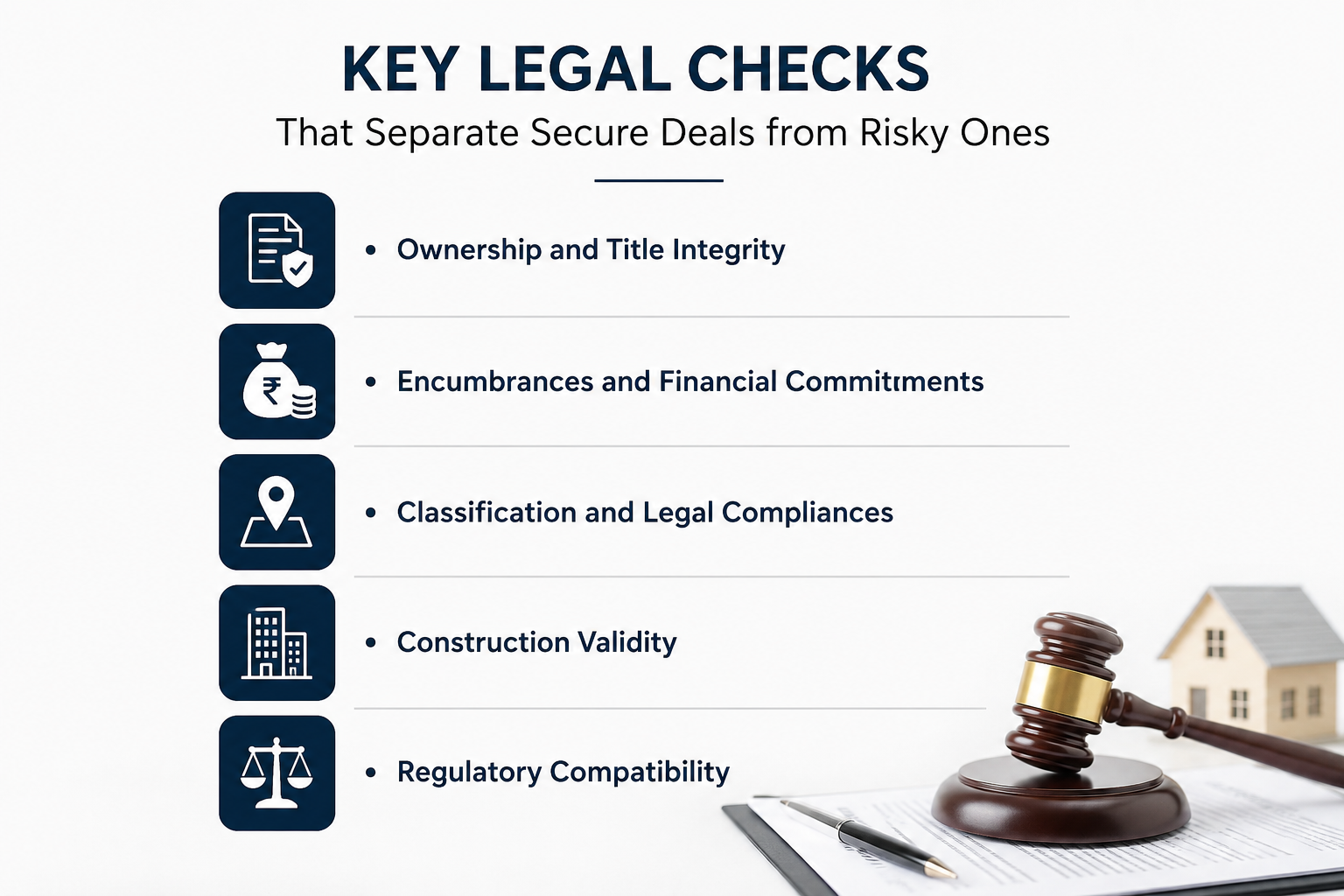
Ownership and Title Integrity
The title needs to be free from any impediments and be accompanied by a full ownership history. An interruption in this chain is always a possible threat.
Encumbrances and Financial Commitments
An encumbrance check shows whether there are existing loans, debts, and third parties claiming the property. Buyers commonly neglect this process.
Classification and Legal Compliances
The land has to be classified as fit for a certain use. Incorrect classification remains a frequent reason for litigation in growing cities.
Construction Validity
Regardless of how safe and sound the land ownership is, construction has to meet the approved plan. Noncompliance may be punishable by fines or demolition.
Regulatory Compatibility
When the deal includes construction, it must also pass a regulatory check. This guarantees the safety of both parties and protects a buyer from further disputes.
Such steps are integral parts of professional residential real estate transactions.
Early Warning Signs That Should Not Be Ignored
Transactions that involve fraud often have certain behavior patterns. Documents may look alright, but processes involved in them provide crucial insight.
Be wary if there is:
- Insistence by the seller on speedy conclusion without time for verification
- Pricing that is much lower than what is common for no apparent reason
- Selective and late sharing of documentation
- Reluctance from the seller side to undergo legal checks independently
- Payment methods which include informal or undocumented payments
These are clear signs of increased risk and need careful consideration before moving forward.
The Role of a Real Estate Company in Delhi in Risk Mitigation
In complicated environments, one-on-one verification alone falls short. That is where an experienced real estate company in Delhi plays its part.
The first thing an expert company will not do is rely entirely on whatever the seller offers. Instead, it develops its own verification mechanism that involves:
- Independent cross-referencing of owner documentation
- Validation of the documentation according to legal requirements
- Identification of irregularities before concluding any deal
- Developing deals that favor the buyer
Having professionals at your disposal through 3sbuildcon allows you to base your decisions on factual information.
Why Independent Legal Oversight Remains Essential
Independent legal verification still remains crucial regardless of the presence of professionals in the area. A property deal requires prolonged financial investment and even minor mistakes might prove to be rather serious.
An independent lawyer analyses:
- The validity and enforceability of legal documents
- Possibilities of existing or future lawsuits
- Conditions in contracts and underlying liabilities
- Compliance with laws
This process helps achieve an understanding which is hard to obtain based on superficial evaluation alone.
Long-Term Impact of Weak Due Diligence
Consequences will rarely manifest themselves instantly; they become noticeable at the point when you decide to resell the asset or transfer the ownership into another name.
Some of the possible outcomes might include:
- Delayed or impossible resale due to unclear title
- Financial losses due to disputes concerning the ownership
- Prolonged legal battles
- Decreased asset credibility in formal transactions
Avoiding Real Estate Fraud means avoiding all these problems.
Building a Secure Approach to Property Buying
The only possible method of mitigating any risks in real estate is through taking a step-by-step approach. It includes prioritizing documentation and information confirmation over the convenience and speed.
Serious buyers adhere to this plan:
- Check all documents independently
- Consult an attorney as early as possible
- Never use off-the-record payment methods
- Cooperate only with certified specialists
- Keep all records of the transactions
Although this approach will require you additional time at the beginning of the purchasing process, it guarantees your safety.
Conclusion
The property becomes fully yours not when the deal is sealed, but when you know that it is completely secure. In the contemporary real estate market, where any risk can be camouflaged by impeccable documentation, due diligence remains the best tool to protect yourself.
Real Estate Fraud can be prevented if you keep your head and proceed according to the plan mentioned above. A real estate investor must be careful, prudent and always ready for surprises.